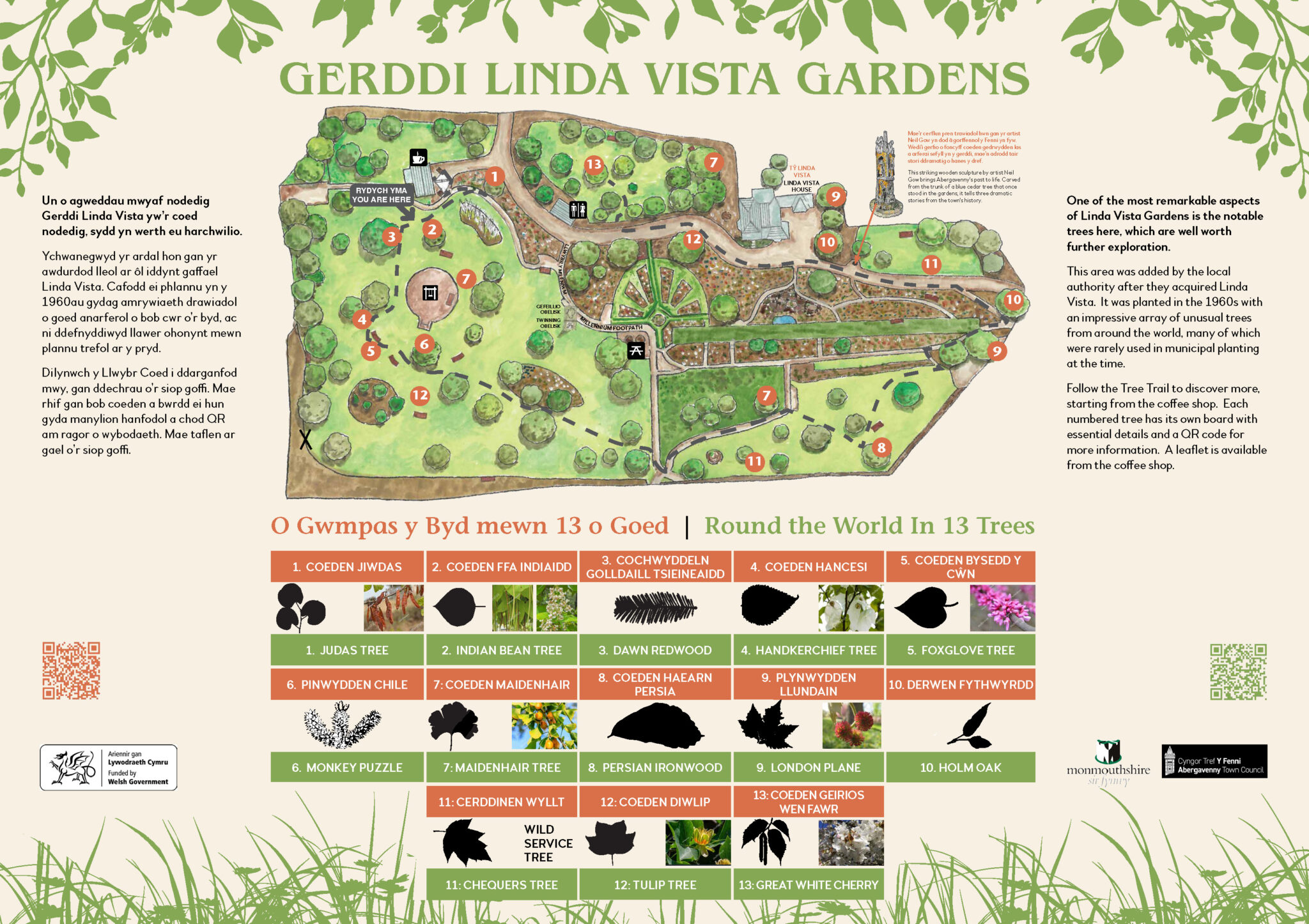
Round the World In 13 Trees – Linda Visa Gardens
The Judas tree grows to a height of 5-7 m. But it can live up to 100 years.
The tree has a prolific display of clustered rosy-lilac flowers that appear in spring on bare branches before the heart-shaped leaves appear. This ensures the tree stands out visually and attracts pollinators such as bees and butterflies. The flowers are followed by dark seed pods in July. (There is a range of flower colour from pink to purple and there is also a white cultivar.)
The name Judas tree derives from the myth that Judas Iscariot hanged himself from a tree of this species, causing its white flowers to turn red. This is likely to be due to a translation error. Cercis trees, common in the Middle East, were referred to as ‘arbre de Judée’, meaning Judea’s tree in French.
It is a leguminous tree, in the pea family.
This specimen was planted by the Whiteheads, probably associated with the creation of the new drive.
Introduced by Mark Catesby in 1726 from the USA, who reported the local Native American name for the tree as ‘katalpa’ or ‘kuthlpa’.
The tree is characterized by its large, bright green, heart-shaped leaves, showy, bell-shaped white flowers with purple and yellow speckles in late summer, followed by very long, dark-brown slender bean-like seed pods which persist into winter. These beans can be very numerous, but unfortunately this tree seems to produce very few flowers and beans.
If a young Indian bean tree is pruned to the base in spring, a lot of new shoots develop to form a shrub instead of a tree, and the leaves they produce are larger still. There are two of these shrubs on the shrub bank in front of the house, one at the top and one near the bottom of the bank.
The Dawn Redwood is a vigorous, fast-growing conifer with fibrous, orange-brown bark. Although the shortest of the redwoods, it can still grow to 51m in height. Unusually for a conifer, this species is deciduous and the foliage takes on a tawny yellow colour before dropping in autumn.
The discovery of the Dawn Redwood was one of the most exciting events in the plant world during the 20th century. Metasequoia were known as fossils from the Mesozoic era, the age of the dinosaurs, and thought to have become extinct 5 million years ago, but in1944 a small stand of trees were discovered in a remote village in Szechuan province, Central China which were later found to be a new living species of Metasequoia – a living fossil.
Seed was collected and distributed to botanic gardens in the USA and Europe for cultivation. In the UK a seedling that germinated at the Cambridge Botanic Garden became one of the 50 ‘Great British Trees’ in honour of the Queen Elizabeth’s Golden Jubilee in 2002.
It is now widely planted as an ornamental tree in temperate regions in the northern hemisphere, and also in China, although it remains critically endangered in the wild.
This specimen was planted in the 1960s by Abergavenny Borough Council.
This tree was planted in 2019 to replace a diseased variegated chestnut nearby. It will be a few more years before the tree starts to flower and the handkerchief shaped white bracts covering them appear. The handkerchiefs, which appear in May are large enough to flutter in the breeze, and it is these that attract pollinators. The flowers hang in long rows beneath the horizontal branches.
The tree was discovered in China in 1869 by French missionary Pere David after whom it is named and introduced by the great plant hunter Ernest Wilson in 1904.
This distinctive tree is named after Princess Anna Pavlovna of Russia and has historical significance in various cultures, particularly in Japan, where it was traditionally planted on the birth of a daughter. The tree would then be harvested for wood when the daughter came of age to be married.
The Foxglove tree is one of the fastest-growing trees in the world, capable of growing up to 6 m (20 feet) in its first year. There is a robust root system that can send up suckers along the roots several feet out from the original tree. The original tree, close by, had to be felled in 2023 because of disease, and this replacement tree was planted behind it. Look at the shoots that have grown up from the original root system; the leaves on these shoots are enormous. Flowers will not be seen on the replacement Foxglove tree until it is mature.
The tree was introduced to Europe in 1834 and originates from Japan and China.
The Monkey Puzzle tree is slow-growing but very long-lived – up to 1,000 years. They start producing fruit at about 20 years of age. Male and female cones are found on separate trees. This tree is female and some years, large cones looking rather like a
small pineapple are produced, which fall to the ground in autumn. They contain up to 200 seeds, which are edible. Male cones are smaller and hang from the lower branches; the larger female cones are borne on the top of the tree
The monkey puzzle has been around for about 200 million years, and so is considered a living fossil. It is found on the slopes of mountains and volcanoes in the Andes mountains in Chile where it is the national tree
The bark is very thick and sticky with resin, which makes it resistant to the heat of volcano lava flows, but the oil rich leaves burn relatively easily in forest fires which have become more common recently.
The dark green leaves are thick and leathery, and triangular in shape with a sharp spike at the end. It has been suggested that the leaves evolved to prevent dinosaurs grazing on them.
It became a ‘must have’ plant for Victorians after it was re-introduced in 1844 and seedlings became available. The common name monkey puzzle, dates back to a planting in Cornwall when a visitor carelessly handling the plant remarked “It would puzzle a monkey to climb that”.
This tree was planted in 1984, and was donated by a local resident.
The Ginkgo joins the Monkey Puzzle and the Dawn Redwood to make the third ‘living fossil’ in our collection of trees that existed at the time of the dinosaurs about 200 million years ago. The Ginkgo survived in isolated temple gardens and monasteries in China and Japan.
The Ginkgo is now an important street tree in China – and elsewhere – as it is disease resistant and tolerates air pollution caused by heavy traffic. It survived the Hiroshima atom bomb explosion in Japan at the end of the Second World War.
The Ginkgo is considered to be the national tree of China and has distinctive fan-shaped, greenish-yellow leaves that have two or more distinct lobes, which gives it its name ‘biloba’. In autumn, the leaves turn golden. Male trees are preferred as the fruit of the female tree smells very unpleasant.
Ginkgo seeds, leaves and nuts have been used in traditional Chinese medicine since at least the 11th century. However, there is no scientific evidence that ginkgo is useful in treatment.
There are 3 ginkgo trees at Linda Vista.
In late winter/early spring before its leaves emerge, the Persian Ironwood produces small, crimson, petal-less flowers along the bare branches. The tree is in the same family as the winter flowering Witch Hazels. In autumn the leaves become a blend of gold, orange, crimson and deep purple and in winter its bark peels in patches to reveal a smooth mosaic of green, cream, grey and cinnamon tones. As its name suggests, the wood of the Persian Ironwood is notably dense and tough, and in an old tree the wood is so dense that it sinks in water. Historically the wood would have been used for tools that required its quality of durability.
The tree was planted in the 1960s by Abergavenny Borough Council.
The two London Plane trees on the boundary of the gardens are part of the original planting so date back to 1875. They are included on the Woodland Trust Ancient Tree Inventory. (The second one is at the top of the grass bank beside the house.)
Note the large leaves, which turn a rich orange-yellow to copper-brown in autumn, and the multi-coloured bark, which has a camouflage-style pattern of white, brown and creamy colours. The flowers appear in early spring, dangling in ball shaped masses, followed by spiky spherical seed heads. The London Plane has a height of 20–40 m and a trunk up to 10 m in circumference. It was first recorded in 1663. It was planted extensively in Victorian times to weather the pollution of London, being one of the most efficient trees in removing small particulate pollutants in urban areas.
Platanus × hispanica is a cross between Platanus orientalis (Oriental plane), origin SE Europe, and Platanus occidentalis (American sycamore). It has never been found growing wild.
The holm oak was introduced to the UK in the 16th century. The two holm oaks are part of the original planting when Linda Vista was built in 1875, and are on the Woodland Trust Ancient Tree Inventory. One is by the entrance gate from Byefield Lane car park and the second tree is on the grass bank beside Linda Vista house. The common name ‘holm oak’ takes its name from holm, an ancient name for holly. Young leaves are spiny, like holly leaves, while older leaves have smooth edges. Holm oak timber is incredibly hard and strong. The Romans used the wood for making the wheels of carts and carriages, as well as for agricultural tools.
The Wild Service or Chequers tree is a native deciduous tree with edible fruit that tastes
similar to a date. The small apple-shaped fruits are hard and bitter initially, but become softer and sweeter after frost.
The Wild Service tree was once widespread, and in medieval Wales the fruits were used in jams and preserves. Now the tree is confined to ancient woodlands and hedges.
The more common name, Service tree, derives from the Latin for beer ‘cervisia’. It is also called ‘Chequers’, a reference to its brown spotted fruit, which were fermented to make an alcoholic drink before hops were used to make beer.
Many pubs are called Chequers. In Roman times a chequerboard was a symbol for an inn or tavern.
The North American Tulip Tree was one of the very first tree species to come over the Atlantic from the USA to Britain. It was collected by the famous plant hunter John Tradescant the Younger and introduced to Europe in 1688
It is a vigorous tree with distinctively shaped leaves that turn butter-yellow in autumn. You can see them from between the top of the ‘Blue’ flower bed and the grass bed next to it, as some branches lean over quite low. You can also see the spectacular yellowish-green flowers marked with orange bands inside in June/July. They are tulip-shaped and quite large. The tree is in the magnolia genus, which is evident by the appearance of the flowers.
The tree can grow to 12metres in height, and in its native states the timber was used to make canoes and infant cradles.
A second Tulip Tree was planted in 2026 near the coffee shop.
This beautiful cherry has a fascinating history. It originates from Japan where it was thought to be extinct. It was grown and reintroduced to its native country by an English nurseryman ‘Cherry’ Ingram in the 1920s after he took a propagated it from a cherry tree in a nearby garden in England. The original Taihaku tree Ingram helped grow is still flowering in Kyoto and all of the Taihaku in cultivation around the world today are offspring of that one tree in England.
The Great White Cherry, Tai-haku is a spreading tree, with huge snow-white blossoms in April/May. To accentuate the purity of the blossoms, they open at the same time as the coppery green leaves unfold, creating a striking contrast. In the autumn the leaves change to shades of golden yellow. The wide-reaching canopy of the Tai-Haku extends horizontally, more than it does vertically, resembling a crown in shape.
This tree was planted by Friends of Linda Vista in 2023.
The History and Development of Linda Vista Gardens
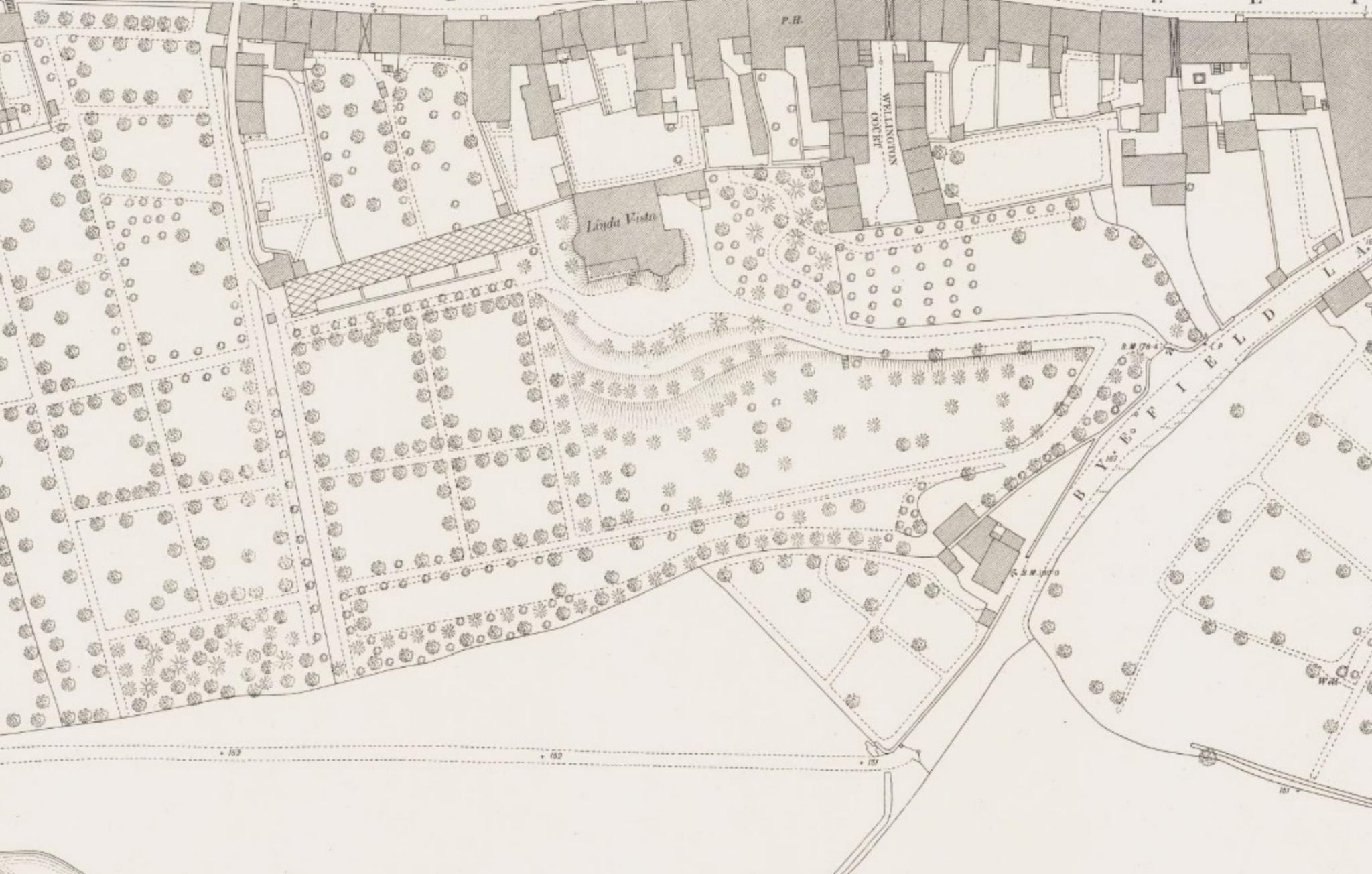
In 1845, the land that would later become Linda Vista Gardens consisted of market gardens and orchards on the edge of Abergavenny.
Linda Vista House was built in 1875 for Henry Jenkins. Jenkins began his working life as a carpenter in Abergavenny but emigrated to Chile during a period of rapid economic growth, where he made his fortune. He returned to Abergavenny to build Linda Vista as a home for his family, but sadly enjoyed it for only two years before his sudden death in 1877 at the age of 47.
His widow, Mary Jenkins, continued to live at Linda Vista until her death in 1895. By that time, the gardens had developed into an impressive landscape, with three terraces on the hillside sloping away from the house, six glasshouses built against the wall backing onto Tudor Street, and extensive productive gardens and orchards.
The main entrance to the gardens, which remains in use today from Byefield Lane (via the car park), dates from this early period. The mature London plane trees and Holm oaks at the entrance are survivors from the Jenkins era and are recorded as veteran trees on the Woodland Trust Ancient Tree Register.
Linda Vista was put up for sale in 1896 but did not find a purchaser for more than a decade. During this period it was rented by James Straker, a local auctioneer and councillor. The Straker family’s connections with the local auction business continue to this day.
In 1907, Linda Vista was purchased by Arthur Whitehead, who had moved to Monmouthshire aged 24 to help manage his family’s steelworks in Tredegar and later Newport. Arthur initially lived at Linda Vista with his older sister Evelyn and his younger brother Alan.
Evelyn Whitehead described in a letter to Country Life magazine the construction of a flight of steps down the steep bank below the house. These steps later defined the western boundary of
what would become the rockery. Arthur and his five brothers all saw active service during the First World War. Arthur and his brother Lionel were badly wounded in 1915 and spent time recovering from their injuries.
By 1921, both Arthur and Alan were living at Linda Vista. In 1922, Alan married Elizabeth Rose Riall of Bray, County Wicklow, and in 1924 Arthur married her older sister, Violet Maud Riall. This marriage would prove crucial to the future development of the gardens.
Arthur Whitehead died in 1927, just three years after his marriage, following surgery. He was only 48. His brother Alan later lived at Plas Derwen in Abergavenny, while Lionel lived at Goytre House. Violet Maud, Evelyn, and the wider Whitehead family would have visited and drawn inspiration from other notable local gardens, including Llanover House, Nevill Hall, Triley Court, and The Hill.
Evelyn Whitehead had already begun reshaping the garden before Arthur’s death, creating the long grass lawn running east–west across the original ornamental garden and the first terraces below the house. Between the 1930s and 1950s, Violet Maud Whitehead and her gardeners developed Linda Vista into one of the most beautiful gardens in the area.
Arthur had earlier created a new drive to the west, connecting the property to Tudor Street. Shrubs and evergreen trees were planted below the drive to screen the productive areas of orchards and vegetable beds. By this time, many of the trees originally planted by the Jenkins family had reached maturity, giving the garden a strong underlying structure.
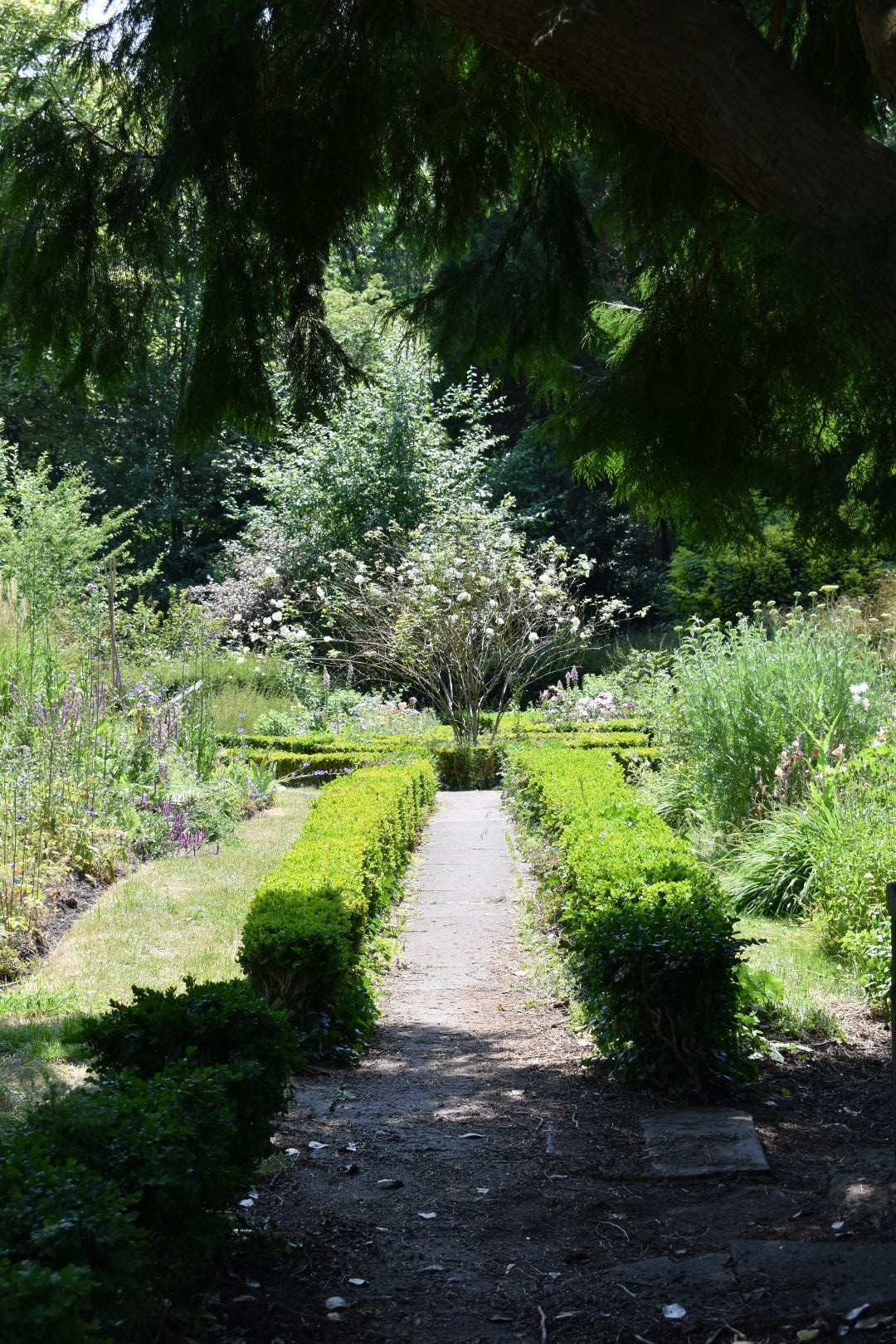
It is likely that Violet Maud Whitehead added the rhododendrons along the long grass lawn, the box edging, a rose garden (on the site of today’s colour-palette garden), and the nerines that provide a striking display in early autumn.
Rock gardens and alpine plants grew in popularity in the early 20th century, and it is likely that the Linda Vista rockery was inspired by these trends. Violet Whitehead’s cousin, Lewis Meredith, wrote an influential book on rock gardens and created an important example near his family home in Ireland.
The sunken woodland garden was probably created later, in the 1930s or 1940s, as the trees and shrubs appear mature in photographs from the 1960s.
After Violet Whitehead’s death in 1957, Linda Vista House and gardens were purchased by Abergavenny Borough Council for £4,000, with additional land added. The intention was to open the gardens as a public park. The house was converted into council flats, one of which was reserved for the gardener, Bill Buttery.
Between 1957 and 1964, a major town improvement scheme led to the demolition of tenement housing in Tudor Street and Byefield Lane. Tudor Street was widened, and the adjacent car park was later created. Demolition rubble was spread across areas that now include the autumn colour arboretum west of the house, as well as the land around today’s coffee shop and play area.
Linda Vista Gardens officially opened to the public in 1965. Photographs from this period show immaculately maintained lawns, formal bedding displays, rose gardens, and mature trees close to the house.
From the 1970s onwards, a number of fine mature specimen trees were lost. A reduction in grounds and gardening staff during the 1980s led to a gradual decline in maintenance. In recognition of its significance, the gardens were designated Grade II on the Cadw Register of Historic Parks and Gardens in 2007.
In 2008, a volunteer Friends group was formed to help maintain and develop the gardens. The Friends of Linda Vista Gardens have since become a vital part of the site’s care, creating new features and helping to conserve its historic character.
The coffee shop began as a temporary “horsebox” before moving into the restored garden shed in 2019, where it has become a popular destination for visitors.
In 2025–26, Monmouthshire County Council secured Welsh Government Brilliant Basics funding to restore key elements of the historic gardens and improve accessibility and the visitor experience. Funding was also awarded to commission a Conservation Management Plan to guide future decisions and ensure the long-term care of Linda Vista Gardens..